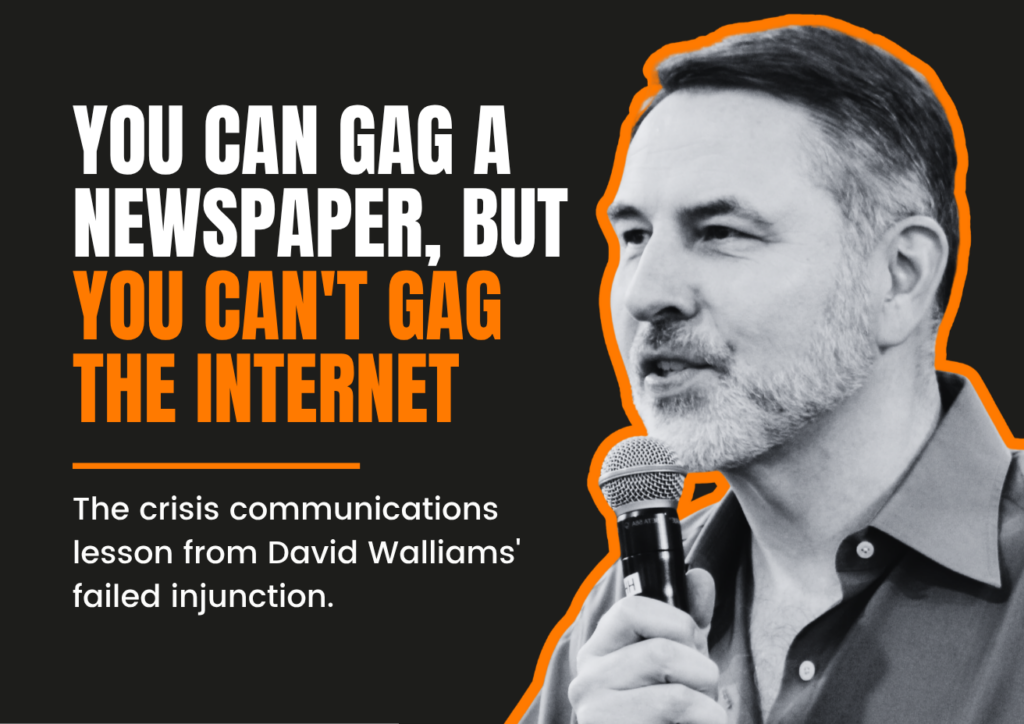
When legal action becomes a bigger story than the one it was intended to stop, what does that tell us about reputation management in the digital age? Here, Satsuma Group’s Managing Director and former national journalist Ellen Widdup explores the Streisand effect, the challenges of crisis communications in the age of social media, and why legal strategy and reputation management must go hand in hand.
For decades, powerful individuals have turned to the courts to prevent damaging information from reaching the public.
An injunction could stop a newspaper publishing a story, prevent a broadcaster naming someone or buy valuable time to manage a reputational crisis.
But the media landscape has changed beyond recognition.
Today, you can stop a newspaper from publishing a name. You can prevent a television news bulletin from identifying someone. What you cannot easily do is stop thousands of people speculating about their identity on social media.
And sometimes, the very act of trying to suppress a story makes it considerably bigger.
The failed injunction brought by comedian and author David Walliams against The Guardian and ITN is a striking example of the challenges facing lawyers, public relations professionals and their clients when legal rights collide with public opinion.
Walliams sought to prevent the publication of allegations relating to his alleged conduct towards young women, including claims of sexual misconduct and abuse of his celebrity status.
He strongly denies the allegations, and the High Court’s decision to refuse an injunction was not a determination of their truth.
His application was based on serious concerns about his mental health and the risk that publication could lead him to take his own life. Those concerns were considered carefully by the court and should not be dismissed or trivialised.
Nevertheless, Mr Justice Nicklin rejected the application, concluding that preventing publication would represent an exceptionally serious restriction on freedom of expression.
Following the expiry of the appeal deadline, Walliams was publicly identified yesterday.
But long before his name appeared in mainstream news reports, speculation about his identity was already circulating online.
And therein lies the reputational problem.
While established news organisations were complying with reporting restrictions, social media users were discussing the case, sharing theories and attempting to identify the individual involved.
The legal proceedings had restricted what responsible journalists could report. They had not eliminated public curiosity or online speculation.
When the restrictions ended, there were effectively two stories – the serious allegations themselves and the extraordinary legal battle that had preceded their publication.
From a crisis communications perspective, that raises an uncomfortable question.
What was the legal strategy actually achieving for his reputation?
There’s a well-established phenomenon in communications known as the Streisand effect.
Named after singer Barbra Streisand, whose attempt to suppress an aerial photograph of her home in 2003 attracted far more attention to the image, it describes how efforts to conceal information can inadvertently amplify public interest in it.
The internet has made this phenomenon particularly difficult to manage.
Attempts to restrict publication can become newsworthy in their own right. People start asking what is being hidden, why someone is so determined to prevent publication and whether there is more to the story.
Of course, not every injunction produces a Streisand effect. Legal action can be entirely justified and effective, particularly where privacy, safety or inaccurate reporting are concerned.
But when a story is already circulating widely online, attempting to contain it through traditional media restrictions can create a dangerous disconnect between legal protection and reputational reality.
Winning a legal argument and winning the battle for public trust are two very different things.
And, as this case demonstrates, even pursuing a legal argument can carry significant reputational consequences.
One of the biggest mistakes organisations and high-profile individuals make during a crisis is treating legal advice and communications advice as entirely separate disciplines.
The lawyers focus on what can legally be said, published or prevented.
The communications team focuses on what audiences are hearing, believing and sharing.
Both are essential. But neither can operate effectively without understanding the other.
A legally sound decision may have disastrous reputational consequences. Equally, a communications response designed to reassure the public could inadvertently prejudice legal proceedings or expose someone to further liability.
That’s why crisis management needs a joined-up approach from the outset.
Before pursuing legal action to restrict publication, there are some fundamental questions worth asking:
Crucially, the answers may not always point in the same direction.
Sometimes legal action is absolutely necessary, regardless of the potential reputational fallout.
But those consequences should be understood, discussed and planned for rather than treated as an afterthought.
There’s another important lesson here. Silence does not mean a story has gone away.
In traditional crisis communications, organisations could sometimes buy time by declining to comment or preventing publication while they established the facts.
Today, an information vacuum is rarely left unfilled.
Social media speculation, anonymous accounts, online forums and private messaging groups can rapidly develop their own narratives.
Some information may be accurate. Much of it may not be.
And unlike professional journalists, anonymous social media users may have little understanding of reporting restrictions, defamation law or the importance of giving individuals a fair opportunity to respond.
This creates a serious challenge.
Responsible news organisations can find themselves legally prevented from publishing verified information while unverified claims spread freely elsewhere.
That is not an argument for abandoning legal safeguards or allowing allegations to be reported without scrutiny.
Quite the opposite.
It demonstrates why responsible, properly evidenced journalism remains so important.
Beyond the immediate crisis communications lessons, the Walliams case raises a much wider issue.
Should access to expensive legal proceedings allow wealthy or powerful individuals to prevent serious allegations from being subjected to public scrutiny?
The courts have an essential role in protecting privacy, personal safety and the rights of people who may be unfairly accused.
Those protections must apply to everyone, including celebrities and individuals facing deeply distressing allegations.
But freedom of expression and investigative journalism are equally fundamental to a functioning democracy.
The cost and complexity of defending legal proceedings can place enormous pressure on publishers, particularly smaller news organisations without substantial legal resources.
And there is a legitimate concern that the threat of litigation can discourage reporting even where there is a strong public interest in publication.
We must be careful not to assume that everyone who seeks an injunction is attempting to evade accountability. In this case, the court considered serious evidence concerning Walliams’ psychiatric vulnerability.
But the broader principle remains important.
The ability to afford an expensive legal battle should not determine whose conduct can be investigated or scrutinised.
Nor should the public interest in serious investigative journalism be confused with an entitlement to gossip, speculate or assume guilt.
Accountability and fairness must coexist.
Ultimately, the Walliams case illustrates something that crisis communications professionals have understood for years.
Reputation is not controlled solely by what appears in the newspapers.
It’s shaped by public perception, personal conduct, the way individuals respond to scrutiny and the information people encounter across dozens of different channels.
Legal action may protect important rights. It may prevent unlawful publication. It may provide vital safeguards for vulnerable individuals.
But it cannot, by itself, restore public trust or control every conversation taking place online.
For businesses, organisations and high-profile individuals, the lesson is clear.
Legal and communications advisers need to be working together before a crisis escalates, not meeting for the first time when the headlines appear.
And every crisis strategy needs to account for what happens when the story escapes your control.
Because the biggest mistake in crisis communications is assuming that because journalists aren’t talking, nobody else is.
And in the age of social media, that assumption can be extraordinarily costly.
At Satsuma Group, we help organisations navigate sensitive communications challenges, manage reputational risk and respond effectively when the unexpected happens. Our crisis communications support combines strategic planning, media law expertise and practical advice when it matters most.

Discover how our creative solutions can elevate your brand and achieve your marketing goals.