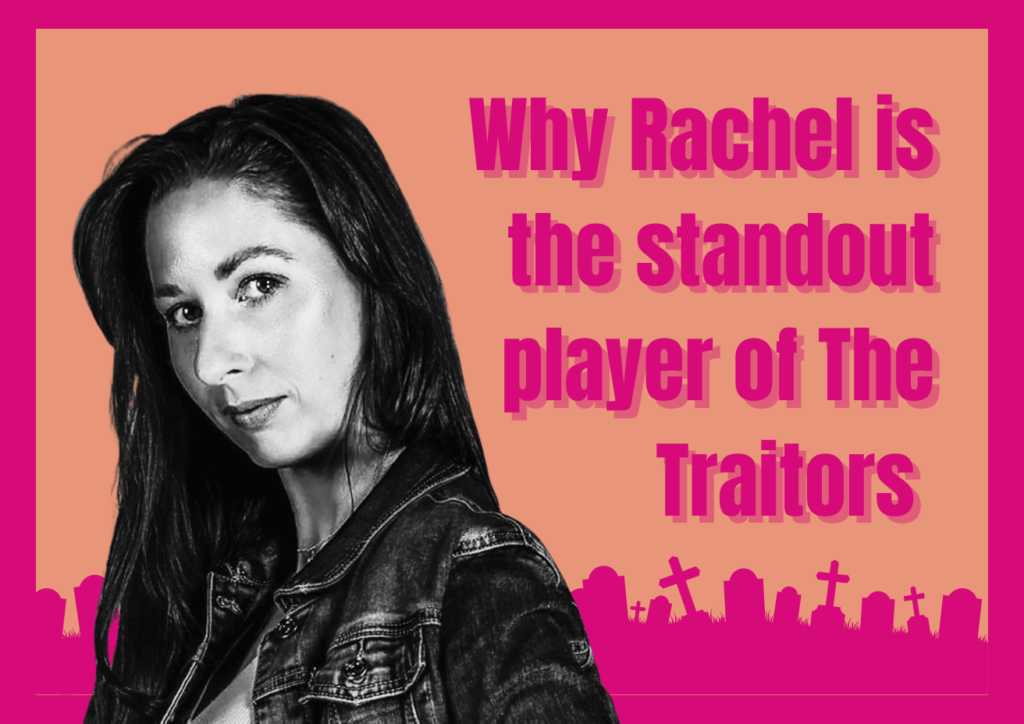
Some players on The Traitors fight for airtime. Others fight for control of the room. Satsuma’s Ellen Widdup explains why Rachel Duffy’s communications instincts are giving her the edge.
There are two ways to play The Traitors.
You can play loudly like barrister Hugo – dominate conversations, rush to fill silences, over-explain yourself and hope confidence carries you through.
Or you can play like Head of Communications Rachel Duffy.
Quietly. Strategically. With a level of emotional intelligence that anyone working in our industry will recognise immediately.
From early on, Rachel stood out not because she spoke the most, but because she spoke at exactly the right moments. She reads the room instinctively. She understands group dynamics. She knows when to listen, when to probe, and when to say absolutely nothing at all.
That’s not accidental. That’s communications craft.
Reading the room is everything
Good comms professionals don’t walk into a situation with a script and bulldoze their way through it. They observe first.
Rachel does this brilliantly. She watches who’s leading, who’s nervous, who’s over-compensating and who’s quietly influential. She’s aligned herself with detective Amanda. She’s clocked the danger lurking under Fiona’s bouncy blow dry.
She understands that influence doesn’t always sit with the loudest voice – often it sits with the person everyone subconsciously trusts.
In comms terms, she’s doing audience analysis in real time.
Who needs reassurance?
Who needs space?
Who’s about to talk themselves into trouble?
She clocks it all – and adjusts accordingly.
Knowing when not to talk is a superpower
One of the biggest mistakes people make in communications is believing silence needs filling.
It doesn’t.
Rachel is comfortable with pauses. Comfortable letting other people speak themselves into corners. Comfortable allowing narratives to unfold without rushing to “correct” them.
That restraint is incredibly hard to master – and incredibly powerful.
In real-world comms, this is the difference between reacting and responding. Between panic statements and strategic positioning. Between amplifying noise and letting it burn out on its own.
Rachel consistently chooses the long game.
Calm beats chaos, every time
Pressure reveals everything.
When tension rises, Rachel’s emotional register barely changes. I mean, did you see how easily she finger printed her murder shortlist in plain sight before sashaying away to rejoin the group? Not a bead of sweat there.
She doesn’t get defensive, escalate emotionally or match other people’s intensity.
In The Traitors, pressure turns many players frantic – defensiveness creeps in, explanations get longer, emotions start to leak. Ross, I’m looking at you.
Rachel stays calm.
That calmness does two things:
- It makes her look credible.
- It makes other people project onto her.
Calm people are trusted people. In boardrooms, media interviews and crisis moments, the same rule applies. If you look steady, people assume you are steady.
That’s not luck. That’s discipline.
She understands narrative control
Rachel never tries to control the entire story – she nudges it. “So Ross…. Did Hugo seem confident in the turret?” Genius.
She drops just enough information. She asks questions rather than making accusations. She reframes conversations subtly, without appearing to steer them.
That’s classic narrative management.
The best communicators don’t shout “this is the message”. They guide others to repeat it for them. They allow the room to arrive at conclusions organically – and take credit without being seen to claim it.
This is why comms people spot her immediately
If you work in communications, you see it straight away.
She’s not playing The Traitors like a contestant.
She’s playing it like a strategist.
She’s managing perception, not popularity.
Trust, not airtime.
Longevity, not moments.
And that’s exactly why she’s dangerous – in the best possible way.
Personal note: I’ve applied twice… so watch this space
Full transparency: I’ve applied for The Traitors twice.
Twice.
Because watching someone like Rachel play the game is basically watching a live masterclass in strategic communications under pressure. And frankly, it’s hard not to think: yes, I could do that.
So… watch this space.