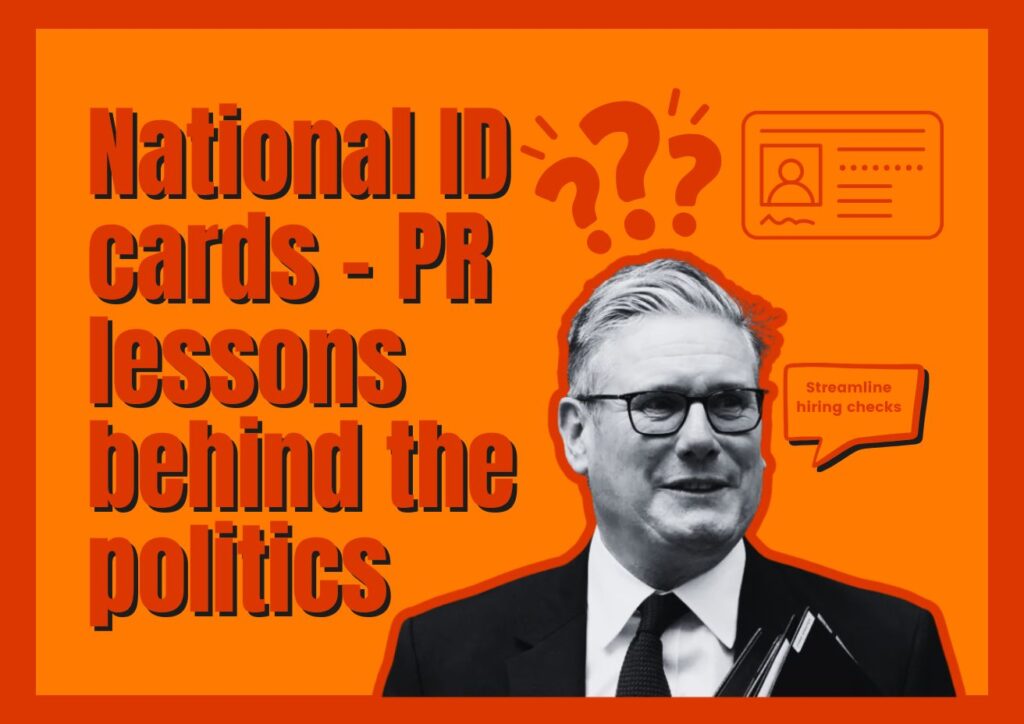
When policy meets public perception, sparks fly – and nowhere is that clearer than in the debate over national ID cards. Here, Ellen Widdup, MD of Satsuma, explains what comms pros can learn from the fallout.
When the government announces something as sensitive as a national ID card scheme, the headlines practically write themselves.
The policy might be about efficiency, fraud prevention and modernisation. The public imagination? Straight to Orwell, Big Brother, and a bloke in hi-vis demanding your “papers please” before you can buy a Tesco meal deal.
For us comms pros, it’s a juicy case study in how policy, perception and trust collide – and how quickly things can go wrong if you don’t own the narrative.
On paper, a digital ID makes sense. Less fraud, less faff, more modernisation.
On TikTok, though? It’s dystopia chic. CCTV on every lamppost, a centralised “citizen score” not too dissimilar to an episode of Black Mirror and someone knocking at your door because you sneezed too loudly after 10pm.
This is partly because when people don’t get the emotional “why”, they fill in the blanks with their own stories – usually involving doom.
Setting out the stall clearly and positively is key with any news that could be divisive. But it’s more than that. It’s also about planning for the inevitable.
Civil liberties groups, privacy campaigners and opposition MPs were always going to criticise. That’s as inevitable as Daily Mail readers being outraged in the comments section.
So good comms is about expecting that. It’s like Christmas with your family. You know Aunt Carol will bring up the fact you are still unmarried, so you have three glasses of wine before she arrives. In PR, you map your critics, prep your answers and never look rattled when the rant starts.
Because once you’re scrambling for a response, you don’t look authoritative – you look guilty. And guilty is not a great brand position unless you’re a true crime podcast.
Policy without people is just bullet points no one remembers. Policy with people is a story – and a relatable one at that.
Nobody warms to “streamlined hiring checks” or “improved fraud prevention protocols.”
But show how a new ID system means a student can register at uni without three different utility bills, or how an NHS nurse can get onto the ward quicker, and suddenly people start to understand the bigger picture.
Humans connect with other humans. Real case studies, messy scenarios, and situations your audience recognises are what turn policy into something that feels like it belongs in everyday life. Without them, you’re basically waving a spreadsheet around and hoping for applause.
And this is where we crash headlong into the issue of trust – the Jenga tower of PR. One wrong move – a data breach, a cost overrun, a whiff of “mission creep” – and suddenly everyone’s on the floor.
And unlike Jenga, you don’t get to just stack it back up and start again.
Once trust cracks, it’s harder to piece back together than IKEA furniture without the instructions. At least IKEA gives you an Allen key.
Every choice of word, every press conference, every slightly sweaty half-smile from a minister – it’s either topping up the trust account or draining it dry. And once you’re overdrawn, no amount of spin will save you. In fact, spin just makes it worse: the harder you whirl, the dizzier everyone else feels.
Trust is earned in tiny moments and lost in one headline.
Which is why comms around something as sensitive as ID cards can’t just be technically accurate – they have to be emotionally intelligent.
If people don’t see themselves in the story, they won’t buy into it. And if they don’t trust you? Game over.
You don’t need to be the government to fall into the same PR pothole.
Any business launching new tech, products or policies – especially anything involving data – is basically walking the same tightrope in a slightly smaller hi-vis vest.
The lesson? Don’t oversell. Don’t sugarcoat. Don’t bury risks in footnotes. Transparency beats spin. Plain language beats jargon. Honest acknowledgement of risks beats glossy promises every single time.
People don’t expect perfection – they expect honesty, empathy and proof that you actually “get” their concerns.
The ID card debate isn’t really about legislation. It’s about the story told, the fears addressed, and the confidence built.
If the government doesn’t get its comms right, it risks losing the audience before the first card even hits the printer.
And businesses, charities and start-ups face the same reality. Own your narrative, or risk being owned by it.

Discover how our creative solutions can elevate your brand and achieve your marketing goals.