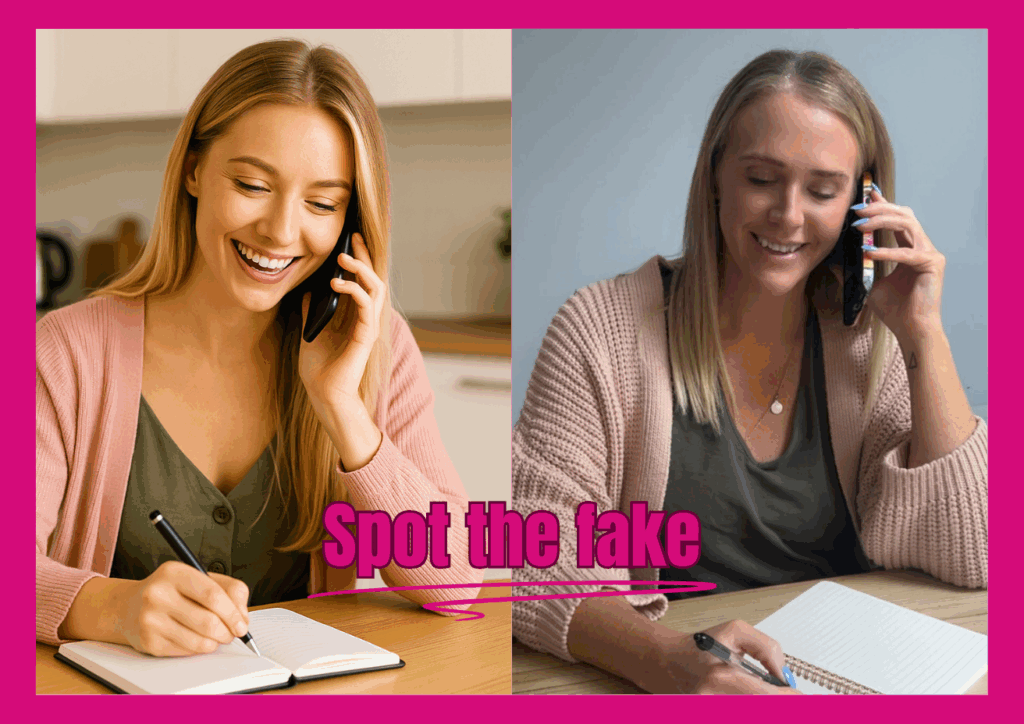
When even school photos are sprouting extra fingers, you know something’s off. Bea Widdup digs into the AI aesthetic that’s taking over our feeds – and how brands can stop looking like they all used the same prompt.
Last Tuesday in the Satsuma office, someone pulled up a school photo of their child. It looked normal at first – bright smile, clean collar, classic blue backdrop. Then someone squinted.
“Wait… are those extra fingers?”
Sure enough, the school photographer’s “AI touch-up” had given one poor kid seven fingers and a ghostly thumb. Cue the collective “ohhh” that only happens when your brain suddenly realises what’s off. Now you can’t unsee it.
And once you do see it, you start seeing it everywhere – in your feed, your inbox, the ads between your Instagram Reels. Flawless lighting. Skin so smooth it looks like it’s never met a pore. Hands that don’t quite look human.
If parents are spotting it in school photos, your customers are almost definitely spotting it in your brand posts.
AI imagery has become scarily convincing. At a scroll’s pace, it passes the test. But stare for a second longer, and the spell cracks. There’s something sterile about it.
The algorithmic aesthetic – that perfectly composed, poreless, painterly look – has become the default visual language of 2025.
And that’s the problem.
When every brand uses the same ‘sunlight through a café window, Gen-Z holding a latte aesthetic’, everyone’s grid starts to look like it came from the same prompt pack. You can’t say you’re all about the personal touch when your visuals are built from stock images and extra knuckles.
So, why does it happen?
AI image models are trained to optimise what’s already popular. They chase trend references, symmetry, and smoothness. In human terms, they pick pretty over real.
That means your AI lifestyle shot of friends laughing in a co-working space will probably look identical to 10,000 others generated this week.
It’s not just dull, it’s a trust hit. People might not always know why they feel uneasy, but they do. Subconsciously, we spot the sameness. We stop believing, because we don’t know what’s real and what’s made up.
Here’s a quick scroll test you can run on your own feed:
Zoom to 125% and scan in this order:
Once you’ve seen the signs, they jump out like bad Photoshop from 2008. I was only a baby then by the way, but still…
Take the now-infamous Willy Wonka Experience in Glasgow. The ads were pure AI Candyland – cascading jellybeans, golden arches, misty chocolate rivers. The actual event? A cold warehouse with two sad balloons and a single smoke machine. Cue mass refunds and a media meltdown.
Or we can recall one of the Trump campaign’s mistakes, when supporters filled Facebook with AI images of Trump surrounded by cheering black voters, trying to promote his inclusivity. When the fakes were exposed, the point they were trying to make collapsed entirely. Instead of connection, they proved disconnection.
The takeaway here is that people will always ask why you chose to fake it. If the real version doesn’t exist, maybe that’s the story that needs to be told.
AI isn’t evil. It’s just easily overused. The trick is to use it as a storyboard, not a billboard.
Here’s how to keep your visual soul intact…
AI lifestyle imagery is now good enough to trick your eyes, but not your instincts. The more brands lean on it, the more they start to blur together in a glossy soup of sameness.
So next time you’re about to post that effortlessly candid shot that took no effort at all, ask yourself, does this look fake to you?
And if you’re not sure, we’ll tell you straight.
Discover how our creative solutions can elevate your brand and achieve your marketing goals.